CRO Shopify
I Studied $100M Brands. These 3 Offers Always Sell

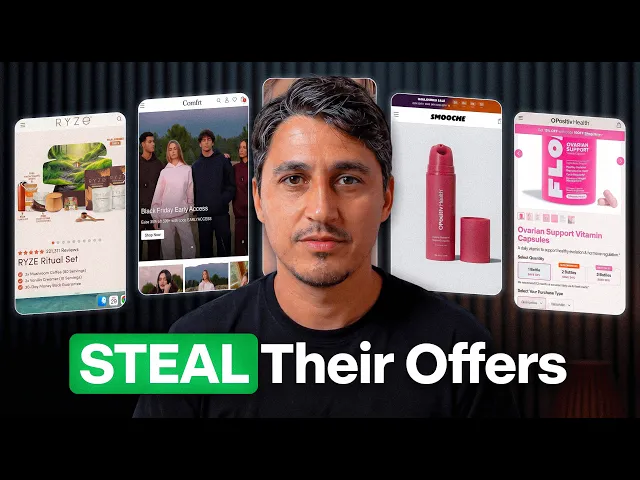
Quick answer: The best Shopify brands don't run bigger discounts, they build better offers. After studying thousands of product pages, I see the same three again and again: a stacked value offer (free gifts only on the bigger option, like Ryze's $56 of gifts on a $57.60 set), a multi-pack offer (more of the same product, ideally framed as "Buy 2, Get 1 Free"), and free shipping tied to a minimum set just above your best seller's price. Below is how each brand runs them and how I built all three on my own store in a few minutes.
Disclosure: this video and post are sponsored by Discounty, and the Discounty links are affiliate links. Ryze, Smooche, O Positiv, Bloom, Javvy, MySweetSmile and Comfrt have nothing to do with Discounty; I only studied their public product pages.
Key takeaways
A discount is a percentage off. An offer is everything the customer gets: the price, the gifts, the bundle, the free shipping and the feeling of a great deal.
A great offer has two parts: the value stack, and the problem it solves that takes more than one unit to solve.
Put gifts on the bigger option, never on every order, pick gifts that help people use the product, and show a crossed-out price on each one.
"Buy 2, Get 1 Free" is the same math as 33% off three, but it feels like a gift instead of a product that isn't selling.
Free shipping should make orders bigger, not margins smaller: set the goal just above your best seller's price and show how much is left.
Don't let the offer stop at the product page. Show every gift and the total saving again in the cart.
Watch the video
Prefer to watch? The 11-minute video walks through every brand's page and builds all three offers live.
Why most stores test discounts, not offers
Most stores put 10% off the product and leave it there, or run a 20% off sale that never ends. When that doesn't work, they try 15%, then 25%, then 30%. That isn't testing an offer, it's testing a discount, and it's the biggest reason stores get stuck.
The brands that make the most money treat the offer as something to test, change and test again, even if it only gets 1% better. And a great offer has two parts:
The value stack: everything the customer gets. The product, the gifts, the price.
The problem it solves, and why solving it takes more than one unit. This is the part most stores forget.
Look at O Positiv. Right under the quantity picker, they tell you they recommend two to three months of daily use for best results. So when someone picks two or three bottles, they don't think "I spent more". They think "I bought enough to actually see it work."
Ryze does the same. Nobody wakes up wanting a bag of mushroom powder; they want a better morning. Ryze suggests two cups a day, so one bag runs out fast, and the 60-serving set becomes the logical choice.
Don't give a bigger discount. Give a bigger reason to buy more.
Related: Shopify conversion rate optimization: the complete guide
Offer type 1: The stacked value offer
Instead of a bigger discount, you stack free gifts on top of the product, and you only give the best stack to the customer who buys more.
How Ryze stacks $56 of free gifts
On the Ryze mushroom coffee page, the first option they push is the Ritual Set, labeled "Best Deal". It comes with two bags of mushroom coffee (60 servings) and two vanilla creamers, then the included gifts: mushroom chocolates, a magnet, a spoon and scoop, an acacia jar and free US shipping. On top of that you pick two more free: an iced coffee glass, latte sticks or a tumbler.

Every gift shows its price crossed out, so you can count it: $12 + $5 + $10 + $25 + $4 = $56 of free stuff. When I recorded, the whole set was $57.60, down from $115. A first order built to feel like it's worth far more than you pay. And it ties back to the problem: a better daily routine, energy and focus without the jitters. Even the box says "your new daily ritual". You almost feel silly picking the single bag.
Smooche: two bottles unlock the gifts
Smooche's best seller is a color-changing foundation. One bottle gets a small discount, and that's it. Two bottles, labeled "Best value", unlock a free Smooche blender, a free mystery gift and free shipping, for about $10 more than one bottle.

If you're going to buy one bottle anyway, why wouldn't you take two? The mystery gift is smart too: the customer doesn't know what it is, so they imagine something better.
Keep the offer alive in the cart
Most stores lose their offer in the cart. Smooche shows it again: two foundations for $49 with $118 crossed out, the blender on its own line (free, $19 crossed out), the mystery gift (free, $15 crossed out), a full free-shipping bar, and total savings of $103 right above the total. At the top, a timer says your order is reserved for the next few minutes.

The customer sees everything they get, how much they save and a reason not to leave it for later, all in the last step before checkout. On the product page, right under the button, there's also a countdown and an "89% sold" bar: a reason to buy more and a reason to buy now in the same place.
Shopify tip: don't let your offer stop at the product page. Show every gift and the total saving again inside the cart.
How to stack gifts the right way
Put the gifts on the bigger option, never on every order. Smooche gives nothing with one bottle; that's why two bottles feel like the obvious choice.
Pick gifts that help people use the product. Ryze gives a spoon and a tumbler for the coffee; Smooche gives a blender for the foundation. Nobody cares about a random tote bag.
Show the value on every gift. A crossed-out price next to each one turns "some free stuff" into real money the customer can count.
There are three levels here. The basic version is a discount only. The better version adds a gift to the bigger option. The best version is a full stack of gifts, with their value shown, on a pre-selected bigger option, the way Ryze and Smooche do it.

Related: How to add a free gift with purchase on Shopify
Build it on your store: a free gift + free shipping with Lumos
To build the same kind of offer on my own test store, I used Discounty, a Shopify app for offers on your product page and in your cart. Its assistant, Lumos, sets up campaigns from a plain-English sentence. I typed:
"When a customer buys two of this patch, add a free travel pouch and give them free shipping."
Lumos prepares the campaign; I check the details and click save. Nothing goes live until I approve it. Normally that's ten minutes of fiddling with settings; here it took seconds.

In the cart: one patch and nothing shows. Add the second patch and the free Travel Pouch drops in ($12 crossed out), and the bar says free shipping is unlocked. Discounty also shows the saving right above the checkout button.

On the product page I added one short line to announce the gift, and every widget matches my store's colors. You set that under Customization in Discounty.
Offer type 2: The multi-pack offer
The simplest offer, and most stores still ignore it. Not a bundle or a different product: more of the same product at a better price.
Bloom, Javvy and O Positiv
On Bloom's Clear Protein page, right next to the price you pick a Single Pack, 2 Pack or 3 Pack. The better price only comes when you buy more: the customer gets a better deal, Bloom gets a bigger order.

Javvy coffee does the same with one, two, three or four-plus bottles, at only 4%, 8% or 12% off. Coffee gets used every day, so people already want more than one bottle.
And remember O Positiv: one bottle saves 29%, two save 34% and three save 36%. The discount barely changes between the tiers. What moves people up isn't the price, it's the line right under it: two to three months. The customer isn't buying more product; they're buying enough time to see it work.

Why "Buy 2, Get 1 Free" beats 33% off
My favorite way to frame a multi-pack is Buy 2, Get 1 Free. MySweetSmile does this on their teeth whitening powder: under "Choose Your Pack" there's a Single Tub, or Buy 2 Get 1 Free.

Buy 2, Get 1 Free is the same as 33% off three products. But say both out loud: "33% off" sounds like a product that isn't selling. "Get one free" sounds like a gift, and people love gifts.
How to set up multi-packs
Bundle the same product, not different ones.
Show the price per item, not only the total. That's what the customer compares. MySweetSmile puts the per-tub price right on each option.
Pre-select the option you want people to buy. Smooche pre-selects two bottles, so the customer has to actively choose to buy less.
When you can, turn the discount into a free item. Same money, much better feeling. And never give the discount for free: make the customer buy more to get it.
Related: How to create high-converting Shopify product pages
Build Buy 2, Get 1 Free (or tiers) with Lumos
In Discounty I typed: "Buy any two patches, get one more free until Sunday." Lumos prepared it, I checked it and saved. On the product page, Discounty shows the offer right above the Add to cart button. In the cart, the third patch comes in free, and the total saving is right there.
If you'd rather run tiers, type something like "Buy 2 save 10%, buy 3 save 20%", and Discounty puts a tier table on the product page.

Offer type 3: Free shipping, done right
Almost every store has free shipping, and almost every store sets it up wrong. Most do one of two things:
Charge shipping on everything, and people leave at checkout.
Give free shipping on everything with no minimum. People buy more, so it looks like it works, but now you pay shipping on every small order. You're paying to make more of the orders that already make you the least money.
How Comfrt sets the free shipping goal
Comfrt gets this right: free shipping on orders over $99, right in the announcement bar. One hoodie won't get you there; a hoodie and sweatpants plus one more piece will.

What I'd add: in the cart, show a few products people can add in one click to reach that goal, like a hat to match the hoodie. O Positiv does this in their cart with products that go well with what you already picked.
Where to set your free shipping threshold
Never give free shipping for nothing. Tie it to a bigger order.
Set the goal just above your best seller's price. One more product should get people there, not three.
Show it everywhere: on the banner, on the product page, and in the cart, with a bar that says how much is left.
Related: 11 proven strategies to optimize conversion rate for Shopify stores
Build a free shipping bar with Lumos
I typed "Free shipping on orders over $55, and show how much is left." Lumos prepared it and I saved it. On the product page, the bar tells shoppers exactly how much more they need: $17 to go on a $38 patch. Add one more patch, and in the cart the bar fills up: free shipping unlocked.

A nice bonus: you can ask Lumos about the campaigns you have running, and it explains them in plain words. Same free shipping you were already giving, but now it makes the order bigger instead of making the margin smaller.
Turn any of these into a Black Friday offer
Every tactic here works great for holidays and sales like Black Friday. In Discounty I asked Lumos to "turn my buy two, get one free into a Black Friday offer that ends November 30", and it updated the campaign for me to check and save.
The Lumos prompts I used
Copy these into Discounty's assistant and change the product names and numbers to yours. Lumos prepares each campaign; check the details before you save.
Discount code: if you want to try Discounty, use code SHOPIOSO for 90% off your first month on all plans, valid until December 31, 2026.
FAQ
What's the difference between a discount and an offer?
A discount is a percentage off the price. An offer is everything the customer gets for buying from you: the price, plus the gifts, bundles, free shipping and the feeling of a great deal. Top brands test the whole offer, not just the percentage.
Is "Buy 2, Get 1 Free" better than 33% off?
It's the same math on three units, but it usually feels better. "Get one free" reads as a gift, while "33% off" can make a product look like it isn't selling. It also requires the bigger order, so you never give the saving away for free.
Should a free gift with purchase go on every order?
No. Put gifts on the bigger option only (two bottles, the full set), pick gifts that help people use the product, and show each gift's value with a crossed-out price.
How do I choose a free shipping threshold on Shopify?
Set it just above your best seller's price, so one more product gets the customer there, not three. Then show the goal on the banner, the product page and in the cart with a bar that says how much is left.
Can I set these offers up without coding?
Yes. Shopify's built-in discounts cover basic Buy X Get Y and free shipping rules, and offer apps like Discounty add the product-page and cart widgets (offer lines, tier tables, free shipping bars) and let you describe the campaign in a sentence.
Do these offers work for Black Friday?
Yes. A gift stack, a Buy 2 Get 1 Free or a free shipping goal all make strong holiday offers. Give the campaign a clear end date, like November 30.
Watch the full breakdown
Watch the full video on YouTube to see every brand's page and the three offers built live.
Want help building offers like these for your store? Work with me.
For more tactics like these, get the Shopioso newsletter.
Which of these three offer types are you planning to run on your store? Tell me in the comments on the video.